


Back
What Is Bipolar Disorder & BAPD? Finding Your Place in a World Built on Balance
10 Min Read
Table of contents
- Want to Learn What Bipolar Disorder Is? Start here.
- So, What is Bipolar Affective Disorder (BPAD)?
- In a World that Rewards Steadiness and Moderation, where does BPAD fit?
- Mania, Depression, and Society
- How does society get confused or misunderstand BPAD as Major depressive disorder?
- Loving Someone with BPAD
- Support for Both Sides.
- You're Not Alone
- FAQs
- Bibliography
Table of contents
Want to Learn What Bipolar Disorder Is? Start here.
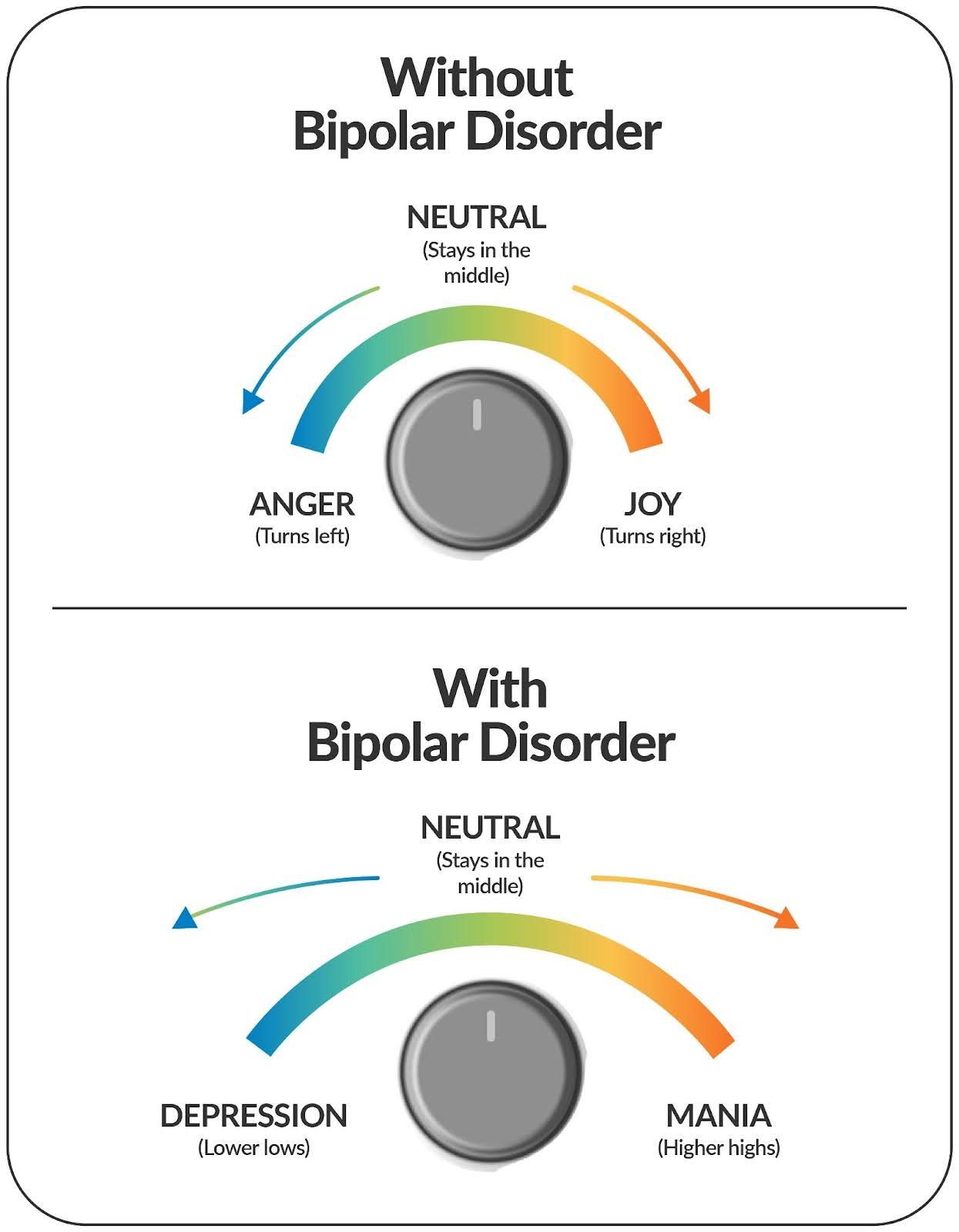
Look back and think about the last time someone told you to "calm down" or called you "too much." How did it make you feel? How did you react? How long did this uncomfortable feeling last? Were you able to let it go eventually? Now imagine your nervous system like a volume knob. If you experience something bad, it goes to say the left, signalling emotions like anger, hate, rage. And if something goes right, you feel happy, joy, glee - your mind switches it to the right. And when you're just having a normal day, the knob knows that it should stay neutral in the middle. No matter what the situation is, this knob is quite rational, and you can adjust it easily. For someone with bipolar disorder, the knob works differently; it has a wider range. The lows go lower than most people's lows. The highs are higher and through the roof. So the instruction to simply "turn it down" ignores the fact that the knob/nervous systems were not built the same way to begin with. Bipolar disorder is a cycle of emotional highs and lows that needs care and understanding The nervous system of people with bipolar disorder, by its very nature, doesn't respond to "calm down" the way other people's do. Not because they are being difficult. Not because they haven't tried. But because of the way their brain processes emotion, energy, and reality, it moves on a different scale altogether. Now, this is where the understanding begins of what is Bipolar Affective Disorder, not through an exhausting list of symptoms, but through the existing gap between someone who experiences the world and how the world expects them to.
So, What is Bipolar Affective Disorder (BPAD)?
Bipolar Affective Disorder (BPAD) is a mood disorder characterised by significant shifts in mood, energy, and activity levels, shifts that go well beyond the everyday highs and lows most people experience. These shifts typically occur between two poles: periods of elevated mood and energy (mania or hypomania) and periods of low mood and reduced energy (depression). Clinically, the DSM-5 identifies three primary types: It involves manic episodes lasting at least seven days: periods of unusually elevated, expansive, or irritable mood and increased energy, often severe enough to require hospitalisation. Depressive episodes typically follow. It involves a pattern of depressive episodes and hypomanic episodes (less severe than full mania, but still a marked departure from baseline), without the full manic episodes seen in Bipolar I. It involves chronic, fluctuating mood disturbances with periods of hypomanic symptoms and depressive symptoms lasting at least two years but not meeting the full criteria for either of the above. The ICD-11 similarly classifies BPAD as a disorder of mood episodes, recognising that it is the pattern of these shifts and their impact on functioning that defines the condition. What both frameworks agree on: Bipolar Disorder is not a character flaw, a personality type, or a consequence of poor emotional regulation. It is a recognised, diagnosable, and treatable condition that affects an estimated 45 million people worldwide. But here's what the diagnostic manuals don't quite capture: what it actually feels like to live with BPAD in a world that wasn't designed for it. And what it costs you socially, relationally, and emotionally when you do. That's what this piece is really about. Sukoon Suggests: Track patterns in your sleep, energy, and behaviour over time to identify early signs of mood shifts and seek timely support.Bipolar I Disorder
Bipolar II Disorder
Cyclothymic Disorder
In a World that Rewards Steadiness and Moderation, where does BPAD fit?
Our world enjoys consistency. Rightly so. Workplaces thrive on showing up reliably, delivering predictably, and evenly spreading out your energy to work on multiple tasks. Relationships depend on trust, predictable mood and behaviour, not feeling blindsided, and someone to lean on. Finally, everything, like our social routines, productivity culture, and basic day-to-day tasks, is done on the assumption that most people roughly feel the same way as they did yesterday. Consistency in many ways is the requirement to participate fully and completely in our social life and the overall social world we live in. If you were the manager for a large team, would you start the day by catching up with them, learning how they’re feeling today, or just move on to the task list? The world, for the most part, assigns the task because that's the expected norm, and someone with BPAD learns very quickly that showing up often involves masking, which is pushing through depressive lows or holding back hypomanic highs to meet expectations, regardless of what is happening internally. BPAD doesn't follow a rhythm. Consistency. A specific pattern. And here is the part that rarely gets said plainly: the system rarely understands how to adapt. The person always does. A person diagnosed with BAPD, in their depressive phase, drags themselves to work. Someone in a hypomanic phase tries to suppress their energy, over-the-top ideas, urgency and reduces being loud and being too much at work. Doing the complete opposite of what you're feeling can lead to extreme exhaustion - this is what researchers call 'masking'. In mood disorders like BPAD, masking can take a toll on a person’s mental health in the long term, leading to delayed diagnosis, social withdrawal and worsening outcomes over time. It's as simple as telling someone not to cry when they already feel a lump in their throat. When we talk about BPAD, we focus on mood and emotions. And when we study their lived experience of how emotion manifests in a society, we need to look at the unwritten rules about how emotion comes in. Sociologist Arlie Hochschild, in her landmark 1983 work The Managed Heart, described what she called feeling rules: the social norms that govern how much emotion is acceptable, in what context, and from whom. Be honest? Have you suppressed emotions that felt too intense? Performed not what you want but what is expected at work? Calibrated yourself to stay within the acceptable range? If yes? That is because you can. Individuals with BPAD struggle with that; regulating and containing their emotions in this way is far more difficult, even when they do manage it, the internal chaos has a severe impact on their mental health. And if by any chance the calibration fails, the world comes at them, labelling them "too much". Furthermore, not everyone will experience the same effects from this collision. Studies consistently demonstrate that women with BPAD take much longer to receive a proper diagnosis; their mood episodes are more often misinterpreted as Major Depressive Disorder, which results in years of undertreatment as the condition worsens (Cascino et al., 2021). According to the Depression and Bipolar Support Alliance, men with BPAD are more frequently misdiagnosed with Schizophrenia, while women with BPAD are far more likely to be misdiagnosed with Depression. These misdiagnoses are influenced more by our expectations of each gender's appearance when ill than by clinical presentation (DBSA, 2000). In other words, depending on who is experiencing it, the same condition can have a different narrative. Within the South Asian context, the significance is even deeper. Research on Indian patients with BPAD found that seeking help is rarely an individual decision; it is mediated by family, shared, and collective, shaped by cultural beliefs and fear of social consequences. Another study found that people with BPAD in India took help from faith healers rather than trusting mental health professionals or even medical doctors, due to the belief in spiritual causes for the disorder and bipolar disorder symptoms. And across urban India, women with mental illness report higher levels of internalised stigma than men. Women experience shame and distress even before facing any external rejection, and are less likely to seek professional help as a result. The exhaustion of individuals with BPAD experience is not just the exhaustion of living with BPAD, but the exhaustion of apologising for it. Sukoon Suggests: Involve one trusted person in your journey who can recognise changes and support you when it becomes difficult to do so on your own.
But if a person 'fails' to achieve that, they're 'too much to handle'
Mania, Depression, and Society
There is a popular narrative around BPAD that goes something like this: society romanticises mania and stigmatises depression. The reality is more complicated and more interesting. Mania, in itself, is not romanticised. What society often does instead is celebrate the output while overlooking the person’s struggles behind it, who created it. Some of the examples are: Paintings by Van Gogh. Poetry by Sylvia Plath. The frenzied output of composers such as Schumann, who composed some of his most well-known pieces during periods of hypomania. In her seminal work Touched with Fire, psychologist Kay Redfield Jamison, who herself suffers from bipolar disorder, examined how many of the greatest artists, writers, and composers in history were most likely suffering from manic-depressive illness. However, this is the part that is silently removed: each of those figures endured great suffering. The artwork is conserved. Their struggles are packaged and aesthetically pleasing, and the pain is almost erased, most importantly, after the person has passed away. Mania doesn't come across as a genius in real life. It puts people on edge. It's too loud, too much, too fast. And yet our culture has been able to appropriate its aesthetic without naming it. Hustle culture rewards the very characteristics that define hypomania: no sleep, relentless productivity, big ideas, unshakeable confidence. What makes this complex is that some traits valued in fast-paced environments, like high energy and constant productivity, can overlap with experiences that, in other contexts, are part of BPAD. The difference is not the behaviour, it’s the diagnosis. This brings us to the other side that isn't as aesthetic - the depressive phase. Research has shown that depressive episodes in BPAD are likely to be longer than manic episodes. It means months of low mood, energy, and functioning. However, this might go unseen as this is not as overt as mania to the people around. Depression in BPAD does not announce itself. People in the depressive phase may be technically present, managing their work, doing their job, performing okay enough and yet for everyone else they would "seem fine". Given that depressive episodes in BPAD tend to last longer, women may face additional challenges, particularly in cultural contexts where expectations around caregiving, emotional regulation, and responsibility are already high.
How does society get confused or misunderstand BPAD as Major depressive disorder?
The high seems real, so the low becomes a choice. The energy was there earlier, so the absence becomes laziness. This is how individuals with BPAD lose relationships, jobs, and basic dignity of having their struggles and lived experience taken seriously. What society has managed to do, then, is not to romanticise one pole and stigmatise the other. It has simply failed both, finding mania inconvenient in person and interesting only in retrospect, and finding depression invisible until it becomes a crisis. Neither version leaves room for the actual person living in between.
Loving Someone with BPAD
Before moving on to this section, let's remember two things: Loving someone with BPAD or any mental illness can be genuinely hard The person with BPAD is not to be blamed for it Once all caregivers inculcate this, half the battle to give the right kind of support is won. Studies consistently suggest that the significant others of a person diagnosed with BPAD experience higher levels of stress and other mental health struggles. A large-scale study of 500 primary caregivers of people with bipolar disorder found that higher caregiver burden was a strong predictor of depressive symptoms in the caregiver themselves over time, meaning the emotional weight of loving someone with BPAD doesn't stay contained. It spreads. Alongside this can come the guilt of feeling exhausted by someone you truly love. Feelings like frustration or even resentment may surface at times, and these responses are more common than we acknowledge. This emotional load often shows up in the small, everyday ways caregivers begin to adapt and stay prepared: Staying hypervigilant, even during stable periods Constantly scanning for early signs of a shift Keeping track of behaviour during manic episodes Supporting daily needs during depressive phases, including food, hygiene, and sometimes work Regulating their own emotions as their loved one’s emotions fluctuate Handling sudden mood changes Trying to understand and anticipate triggers This kind of emotional labour can take a toll on any caregiver, be it a partner, family member, or friend. Research viewing caregiver experiences across decades of literature found that the episodic and recurrent nature of BPAD is particularly disruptive to family dynamics, not just during episodes, but in the in-between, where the anticipation of the next one quietly shapes every interaction. Caregivers can internalise the stigma and devaluing attitude that society also holds towards individuals with mental illnesses. This happens due to exhaustion, burnout, or caregiver fatigue and leads to less adaptive coping. Sometimes stigma, besides affecting the person with the disorder, also seeps into the people who love them as well. People on both sides deserve compassion. They both deserve an equal amount of support and care. PAUSE, TAKE A MOMENT OF SUKOON FOR YOURSELF
Support for Both Sides.
A proper diagnosis is often the first step towards understanding what you are experiencing. Working with a psychiatrist and, where needed, exploring medication and therapy can help create a foundation for managing BPAD over time. Alongside this, there are small, practical ways to support yourself through the ups and downs of BPAD: You have BPAD, you are not BPAD Find communities where both poles are held without judgment Learn to name the cycle without being consumed by it Build a routine with flexibility, not rigidity Know your early warning signs of bipolar disorder, before the episode knows you Grief is part of it - grieving the version of yourself you thought you'd be Celebrate small wins Find a bipolar disorder treatment relationship, not just a treatment, with a good psychiatrist who understands you Read about what BPAD actually is Learn the difference between Bipolar I, II and what episodes look like in practice Watch honest portrayals: Modern Love, Silver Linings Playbook (not for accuracy but to build empathy Understand that behaviour during an episode is not the person's baseline Ask "What do you need right now?" instead of assuming Don't try to logic someone out of a depressive episode Don't try to slow someone down during a hypomanic one by arguing Text to check in Keep showing up even when they push back Talk to a therapist, even once a month Join a caregiver support group Notice when you are struggling Schedule something for yourself every week that has nothing to do with caregivingFor people with BPAD
For loved ones:
You're Not Alone
For many living with BPAD, the experience can feel deeply isolating, especially in environments that expect steadiness and predictability. The gap between internal reality and external expectations often goes unseen, leaving individuals feeling misunderstood or unseen. Yet, this experience is shared by many who are navigating similar emotional landscapes, even if it is not always visible. Some spaces and professionals recognise these challenges and approach them with care and understanding. At Sukoon, the focus remains on creating an environment where this experience is acknowledged with empathy, allowing space for support, clarity, and gradual recovery.
FAQs
Yes, BPAD is very different from regular mood swings. While everyday mood changes are usually short-lived and manageable, bipolar disorder involves intense and prolonged shifts in mood, energy, and behaviour. Understanding what bipolar disorder is helps clarify that these are not just reactions to situations but part of a clinical condition with distinct bipolar disorder symptoms that impact daily functioning. Yes, individuals with BPAD can have meaningful and healthy relationships with the right support and understanding. Recognising the signs and symptoms of bipolar disorder and maintaining open communication can help both partners navigate challenges together. Incorporating small habits like time management techniques can also bring more stability to daily routines, supporting healthier interactions alongside ongoing bipolar disorder treatment. The first step is to learn about the signs of bipolar disorder and approach the person with empathy rather than judgment. Encouraging them to seek help from mental health specialists can make a significant difference, as early identification of bipolar disorder symptoms can lead to better outcomes. Offering consistent support while respecting their pace is equally important. BPAD is a long-term condition, but it is manageable with the right care. While there may not be a complete "cure," effective bipolar disorder treatment, including medication, therapy, and lifestyle support, can help individuals manage symptoms and lead fulfilling lives.Is BPAD different from mood swings?
Can someone with BPAD have healthy relationships?
What should I do if I think a loved one has BPAD?
Is BPAD curable?
Bibliography





+91 8448156500

+91 1244265238


admissions@sukoonhealth.com

Menu